
John Milton went completely blind by 1652, fifteen years before Paradise Lost was published. He did not write it. He couldn't. Every one of its more than ten thousand lines was composed in the dark of his own skull and spoken aloud to whoever was on hand to take it down — a rotating cast of paid scribes, family members, and friends, one of whom was the poet Andrew Marvell.
The method was strange and exact. Milton would compose at night, holding finished lines in memory until morning. When his amanuensis arrived, he'd unload them. And if the scribe was late, he grew agitated — he complained, in the account passed down by his early biographers, that he "wanted to be milked." The image is grotesque and perfect: language as a pressure that builds overnight and has to be let out. The poem existed, fully formed, as sound — before it was ever a mark on a page.
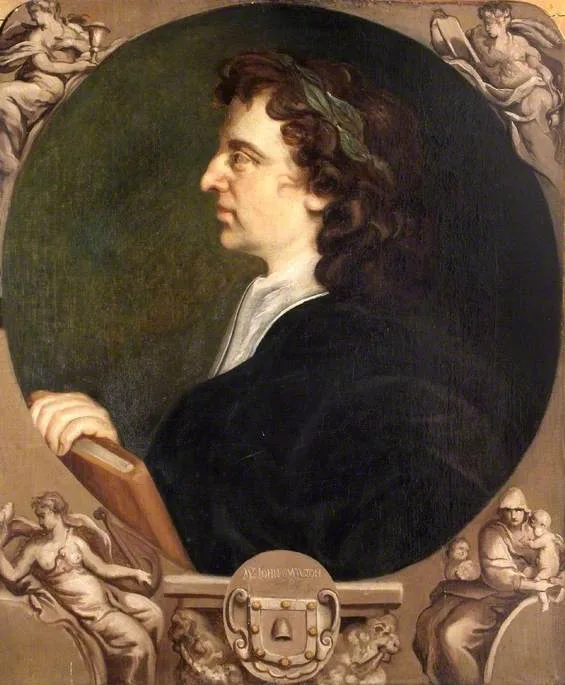
John Milton (1608–1674), portrait attributed to Godfrey Kneller. Blind from 1652, he dictated all of Paradise Lost. Public domain, via Wikimedia Commons.
You've probably seen the painting where his daughters take down his words like devoted secretaries. That's the romantic version — the scene Delacroix and others loved to paint. The truth was less tender and more practical: a working writer with a disability, renting out other people's hands because his own eyes had quit. But the painted legend caught something real, which is that the act itself — a person speaking, another capturing — is old, dignified, and central to how literature actually got made.
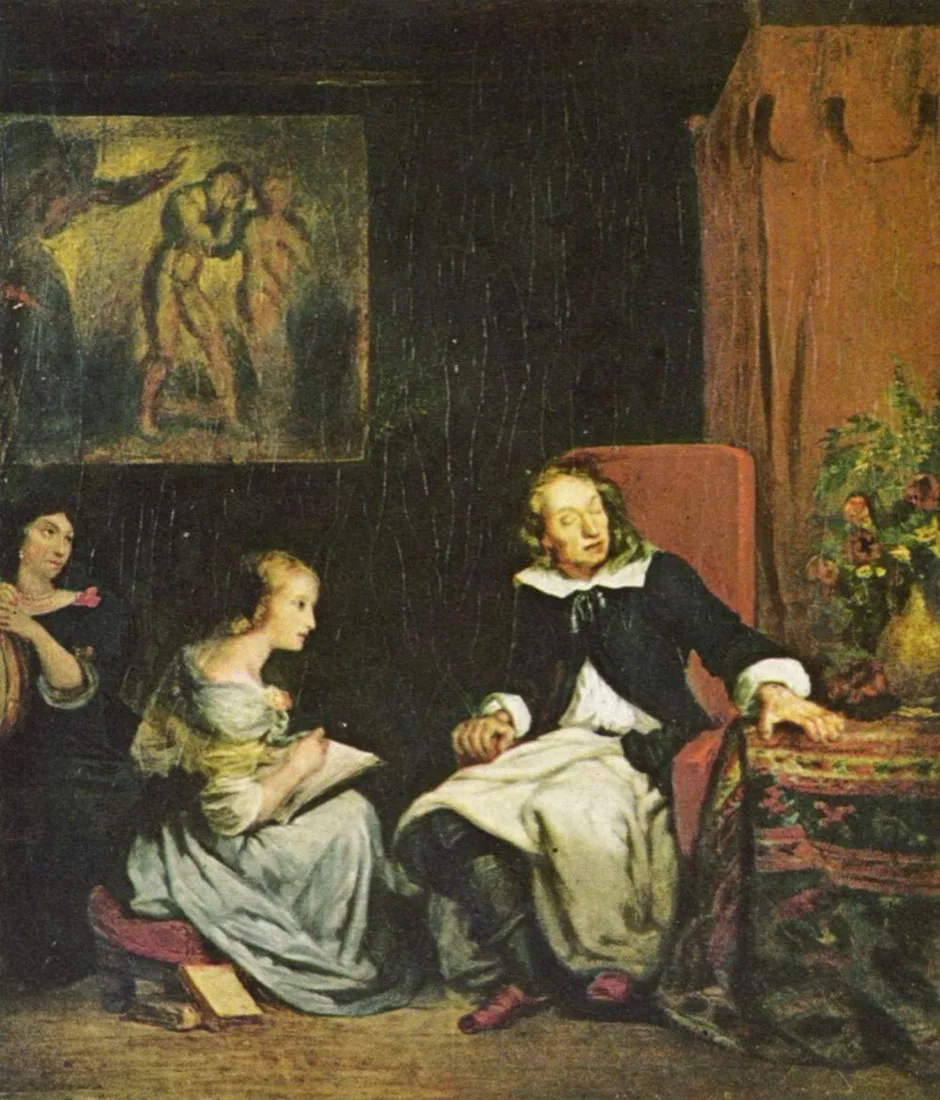
Eugène Delacroix, Milton Dictating "Paradise Lost" to His Daughters (c. 1826) — the legend that made the scene famous. Public domain, via Wikimedia Commons.
Milton had company
Once you start looking, the dictated books pile up fast — and not just among the blind.
Henry James began dictating around 1896, when a wrist crippled by writer's cramp made the pen unbearable. He took to pacing his study and speaking his novels to a typist clattering away at a Remington. By 1907 his amanuensis was Theodora Bosanquet, whom he called his "Remington priestess." His late, famously dense, oral-feeling style — the long unspooling sentences you almost have to read aloud to parse — arrived right alongside the dictation. Whether the one caused the other is debated by scholars to this day, and I'll come back to that, because it's the whole point.
Fyodor Dostoevsky wrote The Gambler by voice under a contract from hell: deliver a finished novel by a hard deadline or forfeit nine years of publishing rights. He hired a young stenographer named Anna Snitkina, dictated the entire book to her in about twenty-six days, made the deadline — and married her a few months later. The novel and the marriage both came out of the same act of talking a story to another person.
Winston Churchill dictated books, articles, and speeches to relays of secretaries, often deep into the night, pacing as he composed. The output was staggering — dozens of volumes — and in 1953 it won him the Nobel Prize in Literature, "for his mastery of historical and biographical description." A body of work that size, by hand, in those years, alongside running a war and a country, would have been physically impossible. He talked it.
And Barbara Cartland turned the method into an industry. Reclining on a sofa, she dictated her romances to secretaries at a pace that produced 723 novels across her life — she could finish a short one in about a week. Say what you like about the literary merit; the logistics are jaw-dropping, and they were only possible because she never touched a pen. Erle Stanley Gardner, the man behind Perry Mason, did the same thing on the other side of the Atlantic, dictating his way to nearly two hundred books after picking up a Dictaphone in 1931.
Not everyone, of course. John Steinbeck filled legal pads in pencil and was famously obsessive about the pencils. Dictation isn't a universal law of genius. But it's a current running straight through the canon, and it's been there far longer than the typewriter, let alone the laptop.
Dictated prose has a different pulse
Here's the claim I actually want to make, and it's where Henry James earns his keep. When you compose by speaking, the sentence has to survive being said — it carries breath, stress, the shape of a voice. Some of James's own friends swore they could point to the exact chapter where he set down the pen and started to speak, because that's where the prose loosens, lengthens, and begins to sound like a man thinking out loud.
Bosanquet, who took down those late masterpieces word by word, said it best. The dictated work, she observed, was different from what the pen had produced: "The final form is not so pretty, but it is ever so much more alive."
That sentence has stuck with me for years, because it names a real trade. Handwriting is composed. It's deliberate, shapely, a little vain. Speech is alive — messier, faster, closer to the actual motion of a mind. Neither is better in the abstract. But they are genuinely different instruments, and a writer who only ever uses one has never heard what the other sounds like in their own work.
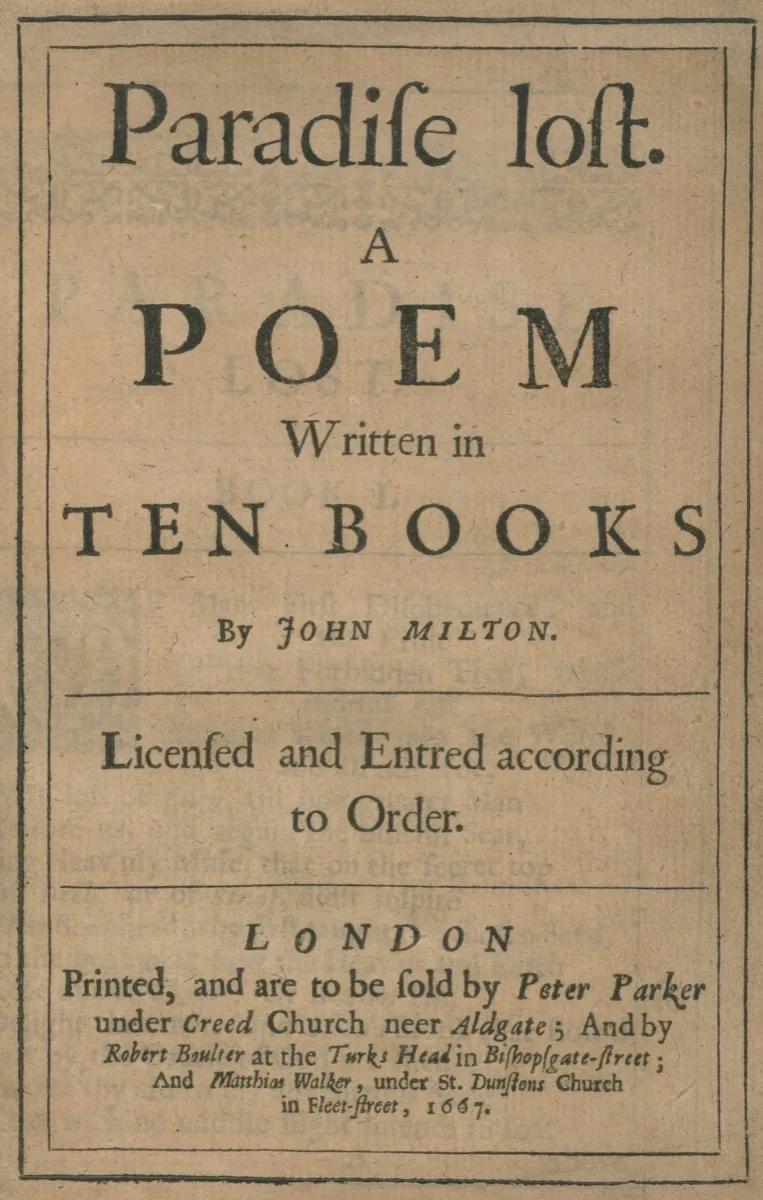
The first edition of Paradise Lost, London, 1667 — the printed afterimage of a poem that was composed entirely as sound. Houghton Library, Harvard; public domain, via Wikimedia Commons.
The scribe was the expensive part
Notice what every one of these writers needed and what it cost them. Milton needed a literate friend on a schedule. James needed a salaried typist and a Remington. Dostoevsky needed a trained stenographer, and he was lucky enough to marry her. Cartland needed a payroll. The bottleneck in five centuries of dictated literature was never the talking. It was the hand on the other end — a scarce, costly, human resource that most writers simply couldn't afford.
That's the part that quietly disappeared. In September 2022, OpenAI open-sourced Whisper, a speech-recognition model good enough to be your scribe — accurate, patient, never late, never needing to be paid. Run it on a modern Mac and the entire apparatus that constrained Milton collapses into a keyboard shortcut. You compose in your head, you speak, and the words appear. The amanuensis isn't a person anymore. It's a model sitting on your own machine.
I build EmberType, so this is the part where you'd expect the pitch, and here it is, kept short: it's Whisper, running on your Mac by default, wired to a hotkey — the scribe with no salary and no server. With its local models, nothing you say leaves the machine, which matters more than it used to now that most "voice AI" tools route your every word through somebody's cloud. Milton trusted his daughters and his friends with the unguarded, half-formed thing a poem is before it's finished. A dictation tool deserves the same trust, and the only way to earn it is to not be listening.
So was yours, maybe
The reason to know this history isn't trivia. It's permission. There's a lingering sense that "real" writing happens through the fingers, that talking your draft is a shortcut, a crutch, slightly cheating. Milton would have found that baffling. So would James, who produced his strangest and most ambitious work only after he started to speak it.
Composing by voice isn't a lesser way to write. It's one of the oldest ways, the way a startling amount of the canon came into being, and — for the first time in five hundred years — it no longer requires another human being in the room. The poem still starts as sound. Now you just need to be ready to be milked.
The scribe with no salary.
EmberType runs Whisper AI on your Mac. Press a hotkey, speak, and your words land as text — anywhere, offline with its local models, and nothing leaves your machine. Milton would have killed for it.
Download EmberType Free7-day trial. $39 one-time after. macOS 14+, Apple Silicon. On-device by default, no account.
Free Mac Dictation Tips
On writing by voice, the history of dictation, and getting more words out of your Mac. No spam.
Unsubscribe anytime. We never share your email.
You're in! Check your inbox.