
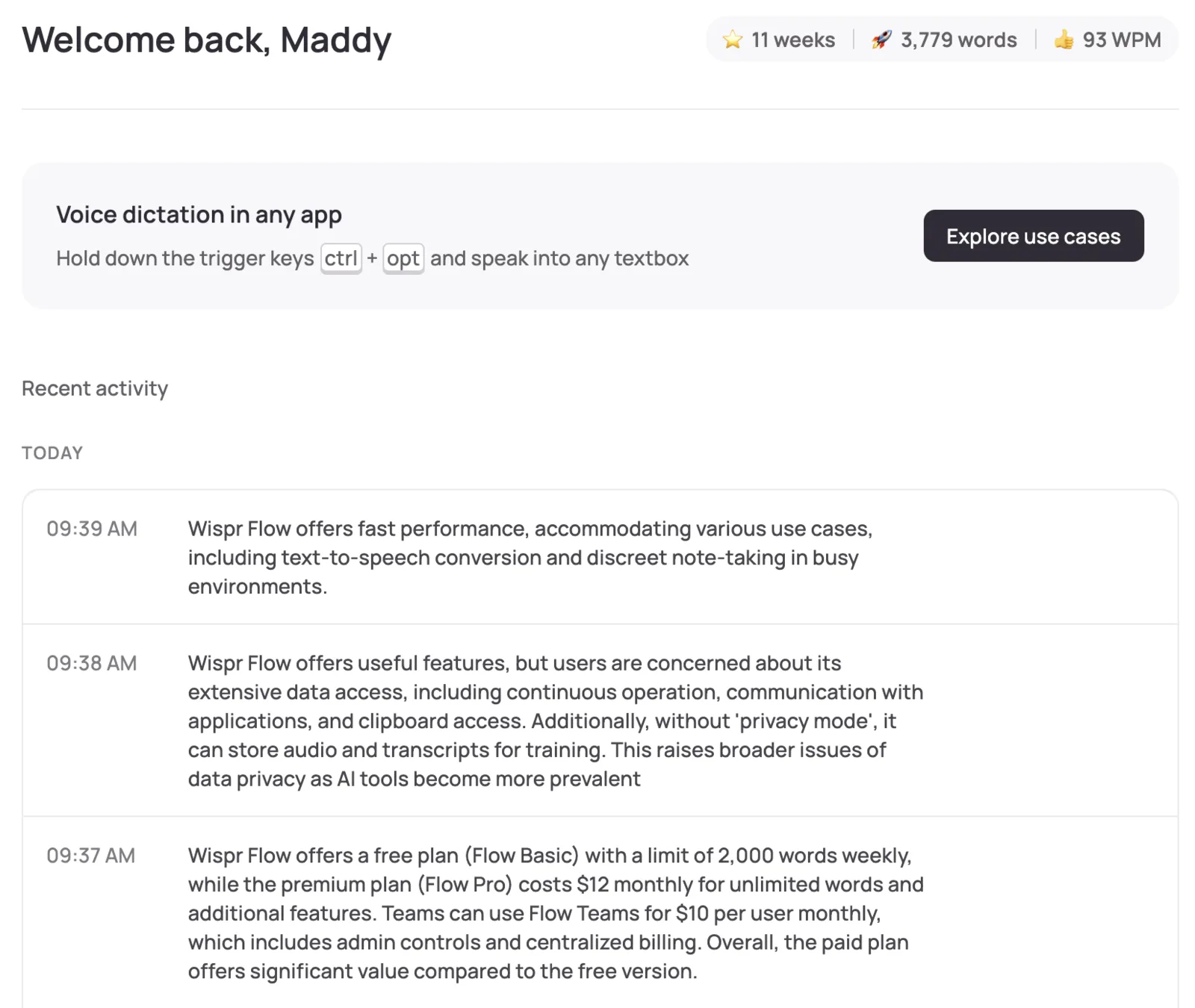
I am not here to bash Wispr Flow
Let me start with the part of this essay that will probably get cut from the social pull quote. I respect Wispr Flow. I have used it. The product is well-built and the team is genuinely talented — they raised serious money, they ship consistently, and they solved a real problem millions of people clearly find valuable. Wisprflow.ai is one of the most polished consumer AI products of the last two years.
None of that is the story. The story is what happened in the first 72 hours after a user noticed something the company would have preferred he not notice, and what that sequence reveals about a class of products that I now build a competitor to. I am writing this not to condemn Wispr — they are a legitimate company run by smart people who recovered from this and are still operating well — but because that timeline contains a lesson about cloud dictation the industry has not fully internalized.
The lesson is this: policy is what a company says it will do. Architecture is what it can do. When the two diverge, only one of them can be enforced by anything other than trust.
What he found
The user did what almost nobody does. He looked at his outbound network traffic.
If you are a developer or a security-minded person, you might run something like Little Snitch, or watch the macOS firewall log, or just open Activity Monitor and notice an app eating bandwidth when it should be idle. That is what happened. Wispr Flow was not just sending audio when he was actively dictating — that was expected, and disclosed. It was also periodically uploading what looked like image data of his active window. To third-party AI infrastructure. Every few seconds.
This was, internally, a feature. Wispr's documentation calls it Context Awareness. The pitch is straightforward: the app figures out which application you are in, what you are working on, and adjusts the tone and formatting of its output accordingly. Dictating into a Slack message? Casual tone, short sentences, lowercase. Drafting an email in Gmail? Cleaner punctuation, complete sentences, professional register. It is a clever feature. The mechanism the early implementation used to figure out what you were working on was, by independent reports including a Voibe writeup that documented the controversy, capturing screenshots of the active window and shipping them to cloud servers including third-party AI infrastructure.
Capturing screenshots of your active window. While you work. To understand what you are working on.
That is not a scandal in itself. Plenty of consumer software does worse without telling anyone. The scandal — to the extent there was one — was that this was not what most users thought they had agreed to when they installed an app called "Wispr Flow" to do voice dictation.
So he posted about it. The thread went viral.
The 72 hours
What happened next is the part I cannot stop thinking about.
The first response was not from Wispr's communications team. It was not from the CTO. It was not a clarifying blog post or an updated documentation page. It was a ban. The user who had raised the concern was banned from the community.
I want to be careful here, because I have been on the other side of moderation decisions for a small product. Sometimes a viral thread brings out behavior that genuinely warrants a ban — harassment, spam, incitement. I do not know exactly what was said in the thread. But every report I have read about the incident frames the ban as a response to the privacy critique itself, not to anything the user did separately, and the company's own subsequent statements support that framing. The CTO's eventual public response, summarized by an eesel AI review, "acknowledged the problems, apologized for how the team handled the criticism (including banning the user who first flagged it), and committed to improving transparency."
So the sequence, as best as I can reconstruct it from public sources: user posts, thread spreads, user is banned, public reacts to the ban, CTO apologizes for the ban, company updates settings and policy. That is the order. The apology came after the backlash. The behavior change came after the apology.
I am not interested in the moralizing version of this. The CTO did the right thing once it became clear it was the only thing left to do. The team built better controls, made data-for-training opt-in instead of opt-out, and rewrote the documentation. By every account I have read since, the current product is meaningfully more transparent than the one that triggered the controversy. The current Context Awareness documentation says the feature reads "limited text near your cursor" through accessibility APIs rather than screenshots. Whether that change was implementation, documentation, or both is not entirely clear from the public record, but the user-facing description is no longer "we ship periodic screenshots of your screen."
Good outcome. Genuinely. I think the team learned from it.
But here is what I keep coming back to: none of the structural facts changed.
Wispr Flow is, by design, a cloud-first product. No setting can make it on-device.
Architecture is the actual story
Look at the technical architecture as it currently exists. According to independent documentation of Wispr's stack, audio is routed to Baseten for transcription, then to OpenAI, Anthropic, or Cerebras for text processing, with storage in AWS us-east-1. There is no offline mode. There is no setting that says "do all of this on my Mac instead." Privacy Mode prevents retention, but it does not change which servers see your data. Your voice still leaves your machine. So does whatever context the app extracts to make its rewriting feel intelligent.
This is not a bug. It is the entire shape of the product. Cloud-first dictation is faster and smarter precisely because it has access to large models that cannot run locally on a consumer laptop without compromise. That is a defensible architectural choice for a consumer product. Most people, dictating most things, do not care.
But here is the thing about defensible architectural choices: they have implications that no policy can soften. If the architecture sends your audio to Baseten, then Baseten has your audio. If the architecture sends a snapshot of your active window to a third-party model provider, then that third-party model provider has a snapshot of your active window. The CTO can apologize. The settings page can grow new toggles. The documentation can be rewritten. None of that changes what was on the wire while the feature was running.
The promise of zero retention is only as strong as the systems and people enforcing it. Maybe Baseten really does delete the audio. Maybe OpenAI's API really does not log it. Maybe AWS's us-east-1 really has not been compromised in a way you would only learn about three years later. Probably all of those things are true. But they are claims, not architectural impossibilities. They are policy. And policy can change — quietly, in a release note, in a Terms of Service update, in a board-level decision after an acquisition, in an employee error, in a subpoena, in a breach you only hear about because some other security researcher noticed it on the wire.
The Reddit user noticed something on the wire. The CTO apologized. The architecture did not change.
The policy-versus-architecture distinction
I think this is the single most important concept in evaluating any privacy-sensitive software, and almost nobody talks about it in product reviews. So let me draw the line as cleanly as I can.
Policy is a promise. "We will not retain your data." "We will not train on your inputs." "We will encrypt at rest." "We will delete logs after 30 days." "Privacy Mode is on by default for enterprise." All of these are policies. They can be true. They can be honestly believed. They can be enforced by audits, by SOC 2 reports, by HIPAA Business Associate Agreements. They can also be wrong — through error, through reorganization, through acquisition, through subpoena, through an engineer who pushes the wrong config to production. When they are wrong, you find out months or years later, if you find out at all.
Architecture is a fact. If the audio never leaves your laptop, no server can have it. If there is no server, no one can be subpoenaed for what is on it. If there is no API call, no API logs can be pulled in discovery. If the model runs in your machine's RAM and writes to your machine's disk and never opens a network socket for the dictation pipeline, then the question "what does the vendor have?" has a structural answer: nothing they did not have before you installed the app.
These two are not the same kind of thing. Policy is reversible. Architecture is not, at least not without shipping a different product. When a Wispr Flow CTO apologizes and changes the defaults, that is policy. When EmberType cannot send your audio to a server because there is no server, that is architecture. One of these is a commitment. The other is a property.
You can prefer either, depending on what you are doing. There are real reasons to want the cloud product — it is smarter, it has bigger models, it can do things a local app cannot. I am not arguing that every dictation user should be running a local model. I am arguing that the question of which one you should be using is determined by your threat model, not by which company has the better marketing. And the way to evaluate a threat model is not to read the privacy page. It is to look at the architecture diagram.
What the apology could not undo
If you were dictating into Wispr Flow before the controversy, and you were a developer working on proprietary code, and Context Awareness was on by default, then snapshots of your code were on someone else's server. That is not a hypothetical. It is what the architecture did. The CTO's apology, however genuine, did not unsend those packets. The updated settings page did not delete them from whatever logs they passed through. Whatever SOC 2 attestation says they were promptly purged is, again, a policy claim about the past.
The reader I keep coming back to: the lawyer dictating client matters into a cloud app that, as a feature, was sending screenshots of her screen to third-party AI infrastructure. The doctor dictating notes that include patient identifiers. The founder dictating a strategy memo that names competitors and acquisition targets. Most of them probably still do not know. The CTO's apology was about the handling of the criticism. The lawyer's privileged communications had already left her machine.
When voice assistants were the cultural villain a few years ago, the conversation was about Alexa and Google Home recording snippets they should not have. Cloud dictation has all the same dynamics, with the additional twist that you are explicitly opening your microphone and inviting the app in. Add a screen-context feature, and you are also handing over a periodic still of whatever is in front of you. You would never let a stranger watch your screen and listen to your microphone all day. But you might install an app that does both, if the marketing is good and the privacy page says all the right things.
Why we made the architectural choice we made
When we started building EmberType, we had to make this exact decision. We could have shipped a wrapper around a cloud API. The dev cycle would have been shorter. The features would have been more impressive on day one — context awareness, multi-turn LLM rewrites, agentic dictation that filled out forms for you. The product would have looked smarter in a demo.
We did not build it that way. We made a single foundational decision: EmberType runs Whisper locally. The app does not transmit your audio anywhere. There is no account. There is no telemetry on your dictation. There is no cloud component to the speech pipeline at all.
The reason is not that we thought we were morally superior to the cloud teams. It is that we did the math on what a similar 72-hour incident would mean for our customers, and we did not want to be the company in that story. If a Reddit user monitors his network traffic on a machine running EmberType, he sees the app phone home for software updates, and that is it. There is no audio leaving. There is no screen content leaving. There is no third-party AI infrastructure in our pipeline at all. The model runs in RAM. The transcription happens on Apple Silicon. The text goes from your microphone to your screen and stops there.
The phrase I come back to when explaining this — particularly to the lawyers and healthcare workers and security researchers who have good professional reasons to care — is this: the only way to be sure your dictation is not being read by someone else is for it to never have a chance to be.
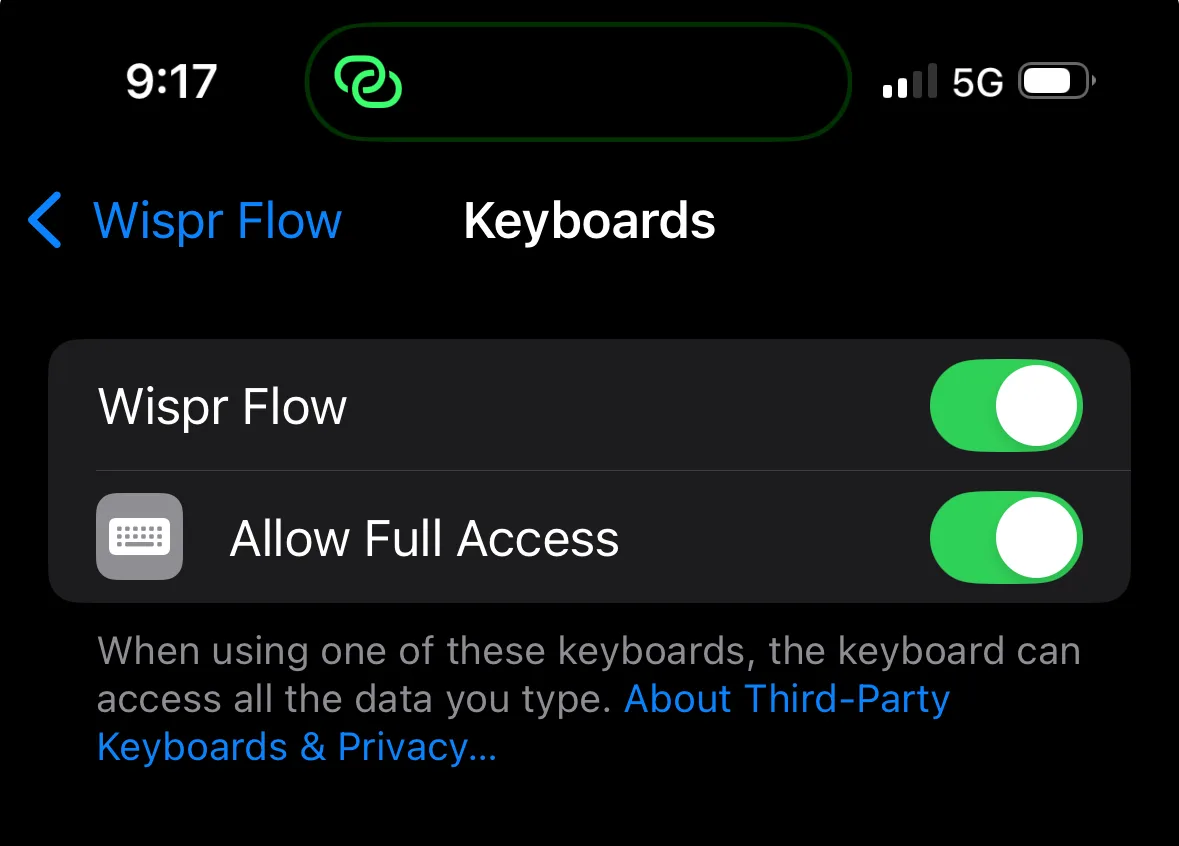 Wispr Flow's iOS keyboard asking for "Allow Full Access" — the permission that lets it see everything you type. Apple's own warning is right there in the settings page. (Screenshot via Zapier.)
The compounding question of trust
The trust surface of a cloud dictation app is not just the company. It is every vendor in the chain. For a typical Wispr request, audio is captured, then sent to Baseten for transcription, then potentially to OpenAI, Anthropic, or Cerebras for cleanup, then stored in AWS us-east-1. That is at least four organizations, each with their own employees, internal access controls, incident response history, and country of operation. Every one of them has a reasonable-sounding privacy policy. The compound probability that all of those policies are correctly applied, at all times, by everyone who will work at any of those companies for the next decade — that is the actual surface you are trusting.
And then on top of that, there is the Delve audit issue from earlier in 2026. Wispr's SOC 2 and ISO 27001 certifications were issued under an automation platform that an investigator alleged shipped 99.8% boilerplate text in 494 audit reports. To Wispr's credit, when this came out they immediately engaged A-LIGN for fresh auditing and switched compliance platforms. But the broader pattern is the same. Compliance is policy. Architecture — what data leaves your machine, and where it goes — is the part you can actually verify by looking at the network.
What I would tell someone considering Wispr Flow today
Honestly? Try it.
I mean that. The product is genuinely well-made. The current privacy controls are meaningfully better than they were before the incident. If you are a casual user — dictating personal notes, drafting non-sensitive emails, talking yourself through a Slack message — Wispr Flow is a delightful product, and the cloud-first architecture is probably a fine tradeoff for the polish you get in return.
But here is the test I would run before committing your professional life to it.
- Open Activity Monitor, or Little Snitch, or any tool that shows you outbound traffic per app.
- Use Wispr Flow normally for an hour. Dictate something into a few different apps. Click around your codebase, your client folders, your medical records system, whatever you actually work in.
- Look at what was sent.
If you are comfortable with what you see, great. The product is doing something genuinely useful and you are paying for it with a clear-eyed view of the tradeoff. Most people, doing most things, will be fine with this answer.
But if you find yourself thinking I'd rather none of that left my machine in the first place — and that thought is reasonable for a lot of people, in a lot of professions — then the architecture is the wrong shape for you, and no settings page can fix that. You want a different category of product. A category that runs locally.
The lesson the story actually teaches
The most useful thing about the Wispr Flow incident, looking back on it, is what it teaches you about how to read privacy claims in general.
Before the controversy, Wispr's privacy page said reasonable things. After the controversy, Wispr's privacy page said reasonable things, with more detail and clearer toggles. In neither case would a careful reading have revealed what the network traffic actually contained, because privacy pages are written in the language of policy, not architecture. They tell you what the company commits to. They do not tell you what the company is structurally capable of.
The user who started the thread was not a journalist. He did not have insider access. He had the equivalent of a network sniffer and the curiosity to look. That gap — between what privacy pages disclose and what architecture does — is the actual story of cloud AI in 2026. It is not specific to Wispr. Notetakers, summarizers, agentic browsers — they all work this way, with vendor chains you cannot fully see and outbound footprints much larger than the on-screen interaction would suggest. They all rely on a stack of trust commitments you can verify only after the fact, by watching your own packets, the way one Reddit user did.
 "Flow for Developers" — Wispr's official developers landing page markets the product heavily to engineers. The engineers who looked at their network traffic found a story.
What architecture buys you, in plain language
If you take only one thing from this essay, take this:
The only way to be sure your dictation is not being read by someone else is for it to never have a chance to be.
This is the entire reason EmberType exists. We are not trying to outpolish Wispr — they have a hundred million in funding and a team of brilliant engineers. We are a small operation building for a different audience: the lawyer who cannot, under bar rules, send privileged communications to a third-party AI layer she has not vetted. The healthcare worker who finds the BAA-shaped hole in most cloud dictation tools insufficient. The journalist with sources. The founder with a not-yet-public strategy. The novelist with a manuscript she is not ready to email anyone, ever.
For all of these people, the cloud architecture is the wrong shape — not because cloud companies are bad, but because the trust surface is too large and the verification is too late. By the time you find out something has gone wrong, your data has already been there for months. The CTO can apologize. The CTO cannot unsend.
If your work is not in any of these categories, the cloud is probably fine. Use the app that fits your use case. I am not on a crusade. But if your work is even adjacent to one of them — and I think more readers than would admit it have at least one document, one transcript, one note that they would rather did not exist on a third-party server — then the architectural choice matters more than you may realize, and "off by default" is not the same answer as "not possible by design."
Dictation that cannot phone home
EmberType runs Whisper AI locally on your Mac. No account. No cloud. No telemetry on your dictation. The architecture is the privacy guarantee — not a setting that can be flipped or a policy that can change.
Try EmberType FreemacOS 14+ · Apple Silicon · 7-day trial · $39 one-time after
A note on the people involved
Wispr Flow's CTO, when the moment came, did the harder thing. He stepped in publicly, acknowledged the issues, apologized for the ban, and committed to changes that have largely been delivered. Most companies in that situation double down and let the story die. He did not. That deserves credit, and I want to give it.
The user who originally posted is, as far as I can tell, still anonymous. He did the kind of small act of public service that almost never makes anyone any money. He looked at his network traffic, posted what he saw, took the social cost of being banned, and indirectly forced a company to change its defaults. I think about him whenever I work on the parts of EmberType that exist specifically because cloud dictation has a class of failure modes a local app cannot have.
The takeaway I want readers to leave with is not "Wispr did a bad thing." It is this: cloud dictation is structurally a category where the bad thing, when it happens, is not recoverable in any sense except policy. The packets are gone. The screenshots are wherever they ended up. The CTO can do everything right after the fact and still not change those facts.
That is why we made a different choice when we built EmberType. Not because policy does not matter — it does. But because we have watched enough adjacent stories play out to know that policy is what gets argued about after the harm has happened. Architecture is what prevents the harm from being possible in the first place. One of these is more boring to market. The other is the one I want my dictation app to have.
Frequently Asked Questions

Privacy-First Mac Productivity Tips
Get occasional notes on dictation, AI tools that respect your data, and what we are building at EmberType. No spam.
Unsubscribe anytime. We never share your email.
You're in! Check your inbox.
Dictation that physically cannot leak
EmberType runs Whisper AI locally on your Mac. No cloud. No account. No screenshots. No "context awareness." Just dictation that stays on your machine, the way it should have been from the beginning.
Download EmberType FreemacOS 14+ · Apple Silicon · 7-day trial · $39 one-time after